The Vision
The landscape, the people and our heritage are inextricably linked. Together they shape identity, belonging and place. Campsie High Kirk is not simply a building within that landscape; it is part of the story that defines it. When we allow such places to disappear, we lose more than stone and mortar. We lose memory, continuity and identity. When we forget that, we forget ourselves.
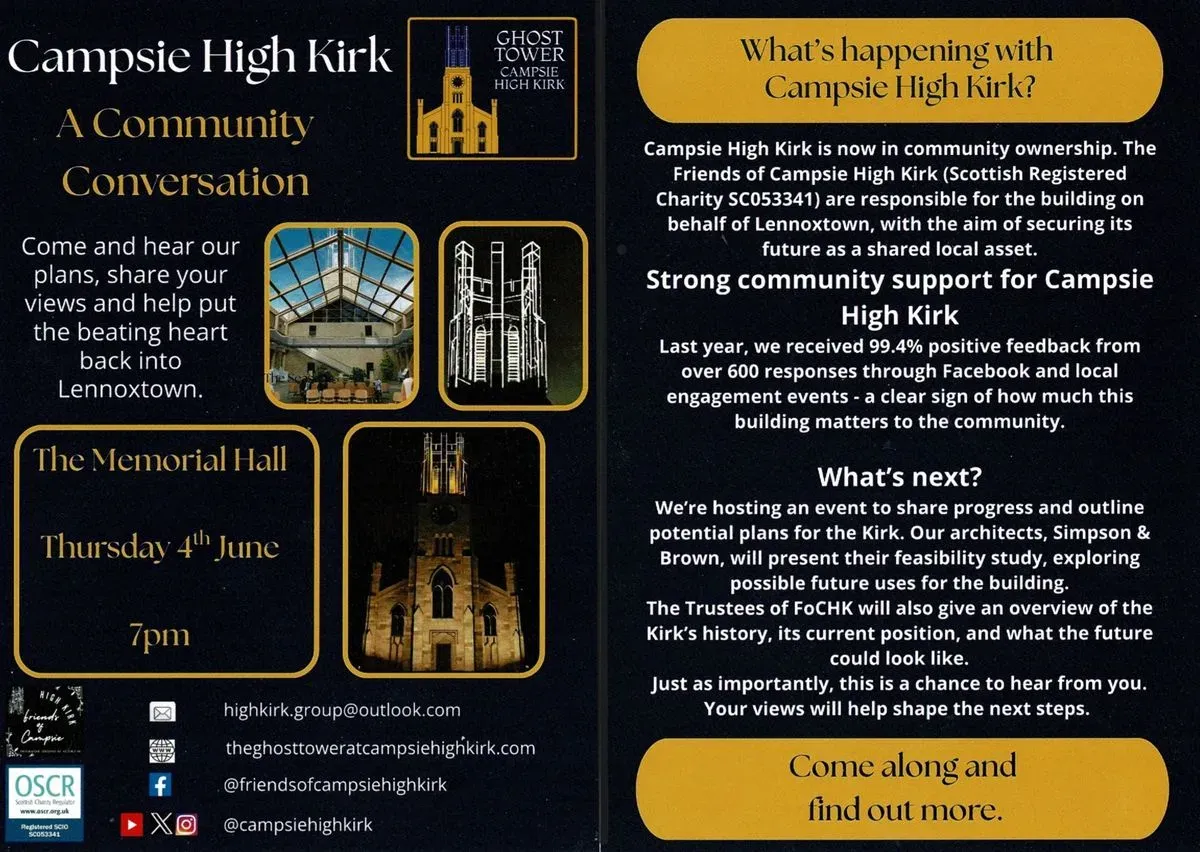
The Feasibility Study – A Blueprint for Community-Led Regeneration
The Campsie High Kirk Feasibility Study is far more than an architectural report. It is the first comprehensive roadmap for transforming one of Scotland's most significant buildings at risk into a catalyst for the regeneration of an entire community. Commissioned by Friends of Campsie High Kirk and undertaken by Simpson & Brown, together with Elliott & Co Structural Engineers and Gardiner & Theobald Quantity Surveyors, the study examines not only how the building can be conserved, but how it can once again become a driver of economic activity, education, culture, tourism and community wellbeing. It establishes a practical, evidence-based pathway from dereliction to long-term sustainability through a carefully planned programme of phased delivery.
Unlike many regeneration projects that begin with a fixed design and a single funding bid, this study recognises that successful regeneration is an evolving process. Every recommendation has been tested against conservation principles, engineering requirements, planning considerations, operational viability, community consultation and financial deliverability. The result is not simply a vision but a realistic strategy capable of adapting as opportunities arise whilst maintaining a clear long-term destination.
A Phased Approach That Builds Momentum
One of the study's greatest strengths is that it avoids the traditional "all or nothing" approach that has prevented many heritage projects from progressing. Instead, the project has been deliberately designed as a sequence of deliverable phases, each providing its own public benefit whilst preparing the foundations for the next stage of investment.
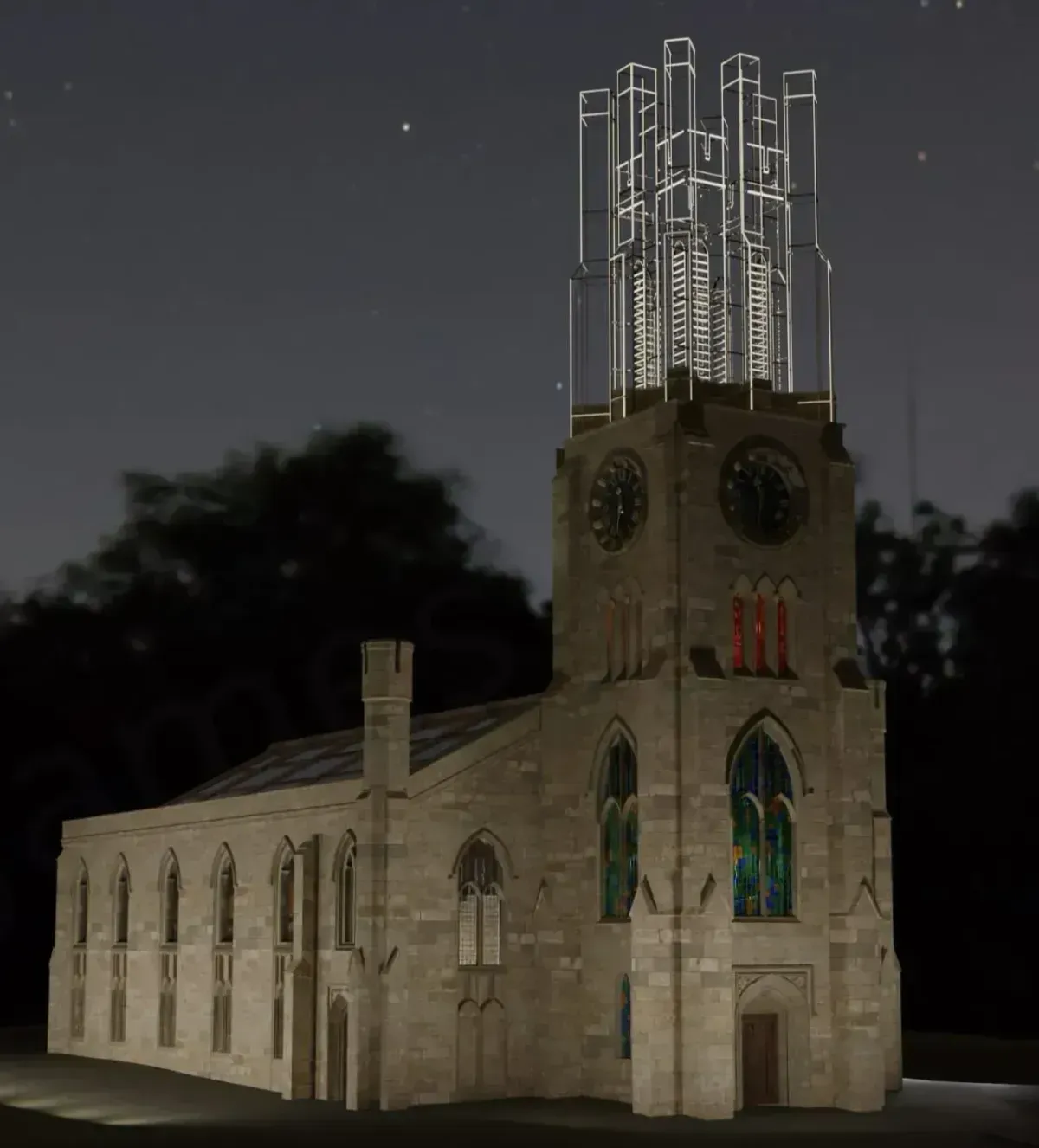
The first phase focuses on stabilising and repairing the historic structure, protecting the nationally important fabric whilst allowing the building to begin serving the community once again. The second phase introduces the iconic Ghost Tower, reinstating the lost silhouette of David Hamilton's tower as a contemporary landmark and powerful symbol of regeneration. Later phases create new accommodation, visitor facilities and carefully integrated modern interventions before culminating in the introduction of a canopy over part of the nave, creating one of Scotland's most distinctive heritage venues capable of supporting year-round activity. Every phase is independently valuable, but together they create a destination of national significance.
This phased methodology also provides funders with confidence. Investment is not being sought for a single speculative outcome, but for a structured programme where each completed stage delivers measurable community, heritage and economic benefits whilst reducing risk for subsequent investment.
More Than Restoring a Building
Although Campsie High Kirk is the focal point, the project has never been solely about restoring a church. The building is being used as the catalyst to reconnect heritage, people and place.
The ambition is to retain an internationally significant historic asset whilst simultaneously creating new opportunities for tourism, education, volunteering, skills development, cultural events, enterprise and civic pride. Heritage becomes the mechanism through which wider regeneration is achieved rather than the end in itself. This approach recognises that historic buildings are not liabilities to be managed but strategic assets capable of stimulating economic recovery, attracting investment and strengthening community identity.
The wider vision extends beyond the walls of the Kirk into the surrounding village, creating stronger connections with local businesses, walking routes, heritage attractions, the Campsie Hills and the wider visitor economy. The objective is to increase footfall, encourage longer visitor stays and help reposition Lennoxtown as a destination rather than simply a place people pass through.
A New Model of Community Empowerment
Perhaps the most significant aspect of the project is that it demonstrates a different model for delivering regeneration.
For too long, communities have often been expected to wait for regeneration to happen to them. Friends of Campsie High Kirk has demonstrated an alternative approach whereby local people identify opportunities, organise themselves, develop professional partnerships and work collaboratively with local authorities, government agencies, national heritage organisations and specialist consultants.
This is not regeneration imposed from above, nor is it simply grassroots activism. It is a partnership between communities and institutions, where strategic support from government enables communities to lead change from the ground up. Power flows in both directions: enabling from the top, leadership from the bottom.
The Campsie High Kirk project therefore represents something larger than a single restoration. It is demonstrating how communities can retain important buildings, repurpose them for contemporary use and regenerate places by bringing together heritage, environment, economy and people within a single integrated programme. It offers a practical model that could be replicated across Scotland and throughout the United Kingdom wherever historic buildings have become symbols of decline rather than opportunity.
Explore the Vision
The pages linked below allow you to explore this journey in more detail.
The Condition Survey and Feasibility Study explain the professional analysis that underpins every aspect of the project and the phased strategy for delivering it.
James Fallan's visualisations, including the internationally distinctive Ghost Tower concept, show how contemporary design can respectfully interpret historic architecture whilst creating a powerful new landmark for Lennoxtown.
The Big Fix Public Consulation Banners
Finally, our Public Consultation Exhibition illustrates how community engagement has shaped the preferred proposals and demonstrates that this has always been a project developed with the community rather than simply for the community. Together they explain not only how Campsie High Kirk can be restored, but how it can become the catalyst for a new model of retaining, repurposing and regenerating historic buildings, places and communities.
The Condition Survey
Before any restoration work can begin, it is essential to understand the true condition of Campsie High Kirk. That is why Friends of Campsie High Kirk commissioned one of the UK's leading conservation architecture practices, Simpson & Brown, to undertake a comprehensive Condition Survey and Feasibility Study. Working alongside specialist structural engineers Elliott & Co and conservation quantity surveyors Gardiner & Theobald, the team has carried out a detailed assessment of the building's structure, stonework, stability and long-term conservation needs. Their work provides the technical foundation upon which every future decision will be based.
The Condition Survey is far more than a simple inspection. It identifies areas requiring immediate attention to ensure the building remains safe and stable, records the extent of deterioration caused by decades of exposure, and establishes the sequence of repairs needed to preserve this nationally significant A-listed building. Alongside this, the Feasibility Study explores how the Kirk can be sympathetically adapted for sustainable community use whilst respecting its remarkable architectural heritage and significance as the only A-listed church designed entirely by David Hamilton. The information gathered allows us to develop realistic restoration options, prepare accurate cost estimates, support planning and heritage applications, and provide confidence to major funding bodies that every proposal is based upon robust professional evidence rather than aspiration alone. This work represents one of the most important milestones in the project's journey from a vulnerable ruin to a sustainable community asset.
A World-Class Vision Born in Lennoxtown
Discover how James Fallan's visionary Ghost Tower concept will help transform Campsie High Kirk into a project with the ambition to become one of Scotland's most distinctive heritage landmarks on a worldwide stage.
The Vision That Changed Everything
Every transformational project begins with someone daring to imagine a different future.
For Campsie High Kirk, that vision began with a simple but powerful idea: the project needed a beacon. Not merely an architectural feature, but a symbol that would shine from the heart of Lennoxtown, invite people from around the world to come and see, and announce that this community once again has the confidence to lead from the front.
That idea found its expression through local architectural designer and digital artist James Fallan. In a moment of genuine creative inspiration, James grasped the essence of the vision and transformed it into something extraordinary. His visualisations challenged people to see beyond a ruined church and imagine what it could become. They gave form to an ambition that words alone could never fully express and demonstrated that this was not simply a conservation project, but the beginning of something capable of transforming an entire community.
At the heart of James’s vision is the now iconic Ghost Tower—a contemporary interpretation of the original upper section of David Hamilton’s magnificent tower, lost in the devastating fire of 1984. Rather than reconstructing what was lost, the design respectfully traces its original silhouette through a lightweight illuminated structure, celebrating both history and innovation. It is an architectural statement that distinguishes new from old whilst restoring the Kirk’s presence within the skyline.
The Ghost Tower has become far more than an architectural concept. It has become the beacon for the wider regeneration of Lennoxtown.
It symbolises resilience instead of decline, possibility instead of abandonment, and investment instead of loss. More importantly, it has become the visual identity of a much larger ambition: demonstrating how heritage-led regeneration can revitalise local economies, reconnect communities with their history and landscape, and create places that people once again feel proud to call home.
Our project is not simply about conserving a historic building; it is about revealing what Campsie High Kirk can become when people share the vision, recognise its magnificent potential, and are prepared to invest their expertise, resources and support in bringing that vision to life.
For almost 200 years the High Kirk has been the defining landmark of Lennoxtown and the architectural, historical and spiritual heart of the community. Our ambition is for it to lead once again—not simply as a restored heritage asset, but as the fulcrum around which the regeneration of Lennoxtown and the surrounding Campsie landscape can gather momentum.
The High Kirk has the potential to become the catalyst for a renewed local economy, attracting visitors, investment, education, enterprise, culture and tourism whilst creating opportunities for local businesses, community organisations and future generations. Heritage, when thoughtfully retained and imaginatively repurposed, is not a cost to society but an investment in its future.
This project represents a different model of regeneration. It recognises that buildings, places and people cannot be considered in isolation. The landscape, the people and our heritage are inextricably linked. Together they shape identity, belonging and opportunity. When we strengthen that relationship, communities prosper. When we neglect it, we lose more than historic buildings—we lose part of ourselves.
Campsie High Kirk demonstrates how community empowerment, supported by government, heritage organisations, businesses and private investment, can retain the past whilst creating opportunities for the future. It is regeneration enabled from the top but led from the bottom up.
James Fallan’s visualisations have become the window into that future. They invite us to look beyond what stands before us today and imagine what can be achieved when creativity, professional expertise and community ambition work together. What begins in Lennoxtown has the potential to become an internationally recognised example of how heritage can regenerate buildings, places, economies and people—in concert.
View the Public Consultation Proposals
Community consultation has been central to the development of the project from the outset. Throughout the design process a number of different concepts and options have been explored before arriving at a preferred direction for the future of Campsie High Kirk. The consultation banners explain the thinking behind the proposals, the opportunities being considered, and how the project could deliver lasting social, cultural, heritage and economic benefits for Lennoxtown and the wider Campsie area.
If you would like to understand the project in more detail, please click the buttons below to explore the Public Consultation material and view the exhibition banners. They explain the proposed layouts, future uses, heritage considerations and long-term vision that have been developed through extensive professional work and ongoing engagement with the community.